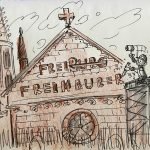


We are standing in front of Freiburg Cathedral, facing the cathedral tower and the main entrance. Freiburg remains a predominantly Catholic city to this day, not least because of the 450-year rule of the Catholic Habsburgs; it has even been a bishopric since 1821.
As is customary in Catholic regions, the veneration of saints has played a significant role over the centuries. Since the Middle Ages, it has been common practice to choose patron saints —that is, saints with whom the city had a close connection for various reasons or from whom the city hoped to receive special protection. The three columns in front of Freiburg Cathedral reflect this fact both directly and indirectly. Therefore, I would now like to introduce Freiburg’s patron saints to you in a little more detail.
At least during the Middle Ages, there was no formal procedure for designating a saint as a city patron; local customs were the deciding factor. It was not until 1630 that it became mandatory for a city patron saint to be chosen by the residents—with the approval of the bishop and the clergy—from among the canonized saints.
The three columns were donated in 1719 by the united estates of Further Austria.
1. Saint George
He didn’t find a place at the top of any of the three columns, but we can find a reference to him in the medallion on the far-left column. This may be because his veneration had declined slightly compared to that of the other saints in the 18th century. Yet he is the city’s first patron saint and is not only depicted here on the fountain, but his red-and-white banner is also immortalized in Freiburg’s coat of arms. It is not entirely clear when St. George became our city’s patron saint. It is possible that he was chosen shortly after the city’s founding, since the city’s founding charter placed particular emphasis on merchants, and St. George was the patron saint of the merchants’ guild. However, it is also possible that he was not officially designated as such until the Habsburg rule, since it was from that point on that Freiburg’s city coat of arms—and thus the connection to St. George—was unequivocally documented. But whenever St. George first assumed the special protection of the city, he did not remain alone in this role for long.
2. Saint Lambert
At first glance, Saint Lambert doesn’t seem to have much to do with Freiburg: He was born in Liège and was consecrated bishop of Maastricht in the year 670. However, he was constantly at odds with the Frankish King Pippin II. He consistently argued that the Church should remain independent of state power and became such a thorn in the ruler’s side that he was murdered in his home in Liège in 705. It is not known for certain who the murderer was, but some evidence points to the Frankish court. Just a few years later, he was venerated as a saint, and his veneration spread rapidly as far as southwestern Germany.
About 450 years later, a man from Freiburg—Rudolf von Zähringen, brother of Duke Bertold IV—was appointed Bishop of Liège, and when he died, he was buried in St. Peter’s. Among his possessions was the skull relic of St. Lambert. His nephew, Bertold V, brought it to Freiburg in 1191. There it was kept in the Schlossberg Chapel until it was transferred to the cathedral in 1366. Since then, he has been actively venerated by the citizens, and it is therefore believed that Lambert became the city’s patron saint alongside St. George as early as the late 14th century. Since that time, joint mentions and depictions of the two saints have also become increasingly common.
3. Saint Alexander
He is certainly our strangest patron saint. St. Alexander is what is known as a “catacomb saint.”
These saints belong to a relatively recent generation of saints: during the armed conflicts of the Reformation era, and especially during the Thirty Years’ War, many relics were lost because they were looted, destroyed, or scattered to the four winds. With the Counter-Reformation of the 17th century, the Catholic Church set out to gather together these relics—which were so important to popular Catholic devotion—in order to strengthen the Catholic faith. A fortunate coincidence came to the Church’s aid in this endeavor: in Rome, in the late 16th century, catacombs containing graves from the late Roman period were discovered. Consequently, the Holy See ordered that thousands of sets of remains be exhumed from the catacombs in Rome. It is unclear whether these remains belonged to individuals of great significance to Christianity; however, some may have been early Christian martyrs. In some cases, the “catacomb saints” were identified with other saints of the same name and assigned the stories associated with them. The relics were assigned names and were transported primarily to German-speaking regions north of the Alps. Although relics were not permitted to be sold, fees were charged for the costly transportation and adornment of the remains. This practice did not cease until around 1860, as canon law prohibits the trade in relics. The remains were often lavishly adorned and dressed and displayed as complete skeletons.
So how did St. Alexander end up at the Freiburg Cathedral?
Freiburg City Councilman Georg Schächtelin and his brother Raphael, superior of the Capuchin monastery in Freiburg, had traveled to Rome for the celebrations marking the Holy Year of 1650. There, they requested that the relics of a saint be granted to the city and cathedral of Freiburg. The Pope then had the remains of St. Alexander handed over to them. These had been recovered from the Catacombs of Priscilla shortly before. We have no reliable information about his identity or his life. It is believed that he was a Roman soldier who lived around the year 300, professed the Christian faith, and was therefore executed during the Roman persecution of Christians. In fact, however, none of this can be proven. Nevertheless, highly official documents were issued by the Vatican stating that the remains belonged to an early Christian martyr named Alexander.
The Schächtelin brothers are said to have carefully transported him across the Alps in a wooden box. On September 21, 1651, St. Alexander was solemnly transferred to the cathedral and enshrined in St. Anne’s Chapel, which has been called St. Alexander’s Chapel ever since. His feast day is celebrated together with St. Lambert on September 17, and for this reason, the two patron saints have generally been depicted and venerated together ever since, causing St. George to fade somewhat into the background. For the somewhat uncertain origins of St. Alexander did not detract from his veneration in the city, as evidenced by the fact that many Freiburg citizens had their children baptized with the names Alexander and Lambertus well into the late 18th century and especially since the erection of the three columns. The shrine of St. Alexander continued to be carried in the Corpus Christi procession until the 1960s, even though the Catacomb Saints had completely lost their significance since the late 19th century. Freiburg is, after all, an open city, and even an obscure Roman saint of uncertain origin is warmly welcomed here.
4. Maria
The Mother of God between Lambert and Alexander is not the city’s patron saint. However, the Freiburg Cathedral is dedicated to her. And since the cathedral is a parish church, she does, in fact, offer special protection to a large portion of the population. The three columns in front of Freiburg Cathedral have now been watching over the hustle and bustle on Münsterplatz for 200 years and have become an integral part of the cityscape.