

deen-usfres +49 (0) 7667 4269631 buchung@kultour-entdecken.com
+49 (0) 7667 4269631 buchung@kultour-entdecken.com
deen-usfres

Freiburg “Sponge City” City Tour: Is this tour right for your group?

A themed tour on climate adaptation makes sense if your group is looking for more than just traditional sightseeing—but how technical, engaging, and group-friendly should it be? The “Schwammstadt Freiburg” city tour appeals to those interested in understanding Freiburg’s “Green City” profile through concrete examples of urban planning. To make an informed decision, the following factors are particularly important:

Depth of content, visual examples, relevance to the target audience, itinerary, and how it differs from other tours. This article explains how to identify a suitable tour, what questions you should clarify before making a request, and when a different format might be a better fit for your program.

What a Good Tour of Schwammstadt Should Offer

A good “sponge city” tour transforms an abstract planning concept into an understandable system. It demonstrates how soils, vegetation, buildings, open spaces, and traffic areas work together to allow rainwater to be stored, infiltrated, or evaporated. The city of Freiburg combines this approach with heavy rain preparedness, urban greenery, and heat mitigation. Technical background information is provided by the City of Freiburg’s Climate Adaptation Concept for Water.

Five criteria are particularly important for the selection process:

  • Clarity: Are the measures explained using real-life examples?
  • Understanding the System: Are water, heat, green spaces, development, and quality of life interconnected?
  • Content tailored to the target audience: Is the presentation appropriate for a tour group, a school class, or a specialized audience?
  • Critical Analysis: Are conflicting goals and limitations also addressed?
  • Transparent Organization: Are the duration, meeting place, group size, and focus areas clearly defined?

When is the “Schwammstadt Freiburg” city tour a good fit for your group?

This tour is ideal if your group would like to gain an understanding of current urban development in the area. It is particularly relevant for tour groups interested in green cities, companies, local governments, expert delegations, universities, students, and school groups. According to the program page, no prior knowledge is required; the presentation and level of detail can be tailored to be generally understandable, educational, or technical.

The key is the shared goal of learning. Anyone who wants to understand how cities can respond to heavy rain, droughts, and heat waves will find this tour a good fit. On the other hand, those primarily interested in Münster, the Bächle, and the city’s history should opt for a traditional Old Town tour.

What kind of content should participants expect?

A compelling tour explains not only individual measures but also how they interact. Relevant topics include rainwater storage and infiltration, urban trees and green spaces, green roofs, soil restoration, shading, summer cooling, and the connection to mobility and quality of life.

Added value comes from asking questions specific to a given location: What areas can absorb water? How do vegetation and evaporation contribute to cooling? Where do buildings, green spaces, traffic, and public spaces compete for space? Water-sensitive urban development combines green and blue infrastructure while also recognizing that climate adaptation itself requires space.
A well-designed tour therefore does not present climate adaptation as a simple, one-size-fits-all solution, but rather as a planning challenge with diverse requirements. For discerning groups, this nuanced perspective is usually more valuable than a mere list of technical measures.

Schwammstadt, the Old Town, or Vauban: Which tour is a better fit?

The selection should be based on the main focus of the content:

  • Sponge City: Rainwater management, heavy rain preparedness, heat protection, urban green spaces, and climate-resilient neighborhoods.
  • Old Town: historic sights, city history, the cathedral, and the Bächle.
  • Vauban: sustainable living, architecture, mobility, and citizen participation.

The “Sponge City” tour does not take place in Freiburg’s Old Town. It can be combined with the Vauban tour because both explore different aspects of the “Green City.” For specialized programs, study tours, and groups with a broader interest in sustainability, this comparison can be particularly insightful.

How can you tell if a placement is of high quality?

Effective interpretation combines observation, explanation, and discussion. A qualified guide should accurately interpret visible features, explain technical terms in an understandable way, and adapt to the group’s level of knowledge. Equally important is a clear narrative structure: from basic principles to specific measures, and on to effects, limitations, and potential conflicts of interest.

Make sure the program takes into account different group profiles. A school class needs different examples than a municipal delegation. The Freiburg program page lists qualified tour guides, local expertise, and a focus that can be tailored as much as possible.

Does the Sponge City tour fit into your schedule?

Check the duration, meeting place, group size, and possible topics on the program page.

How should Freiburg’s specific offer be viewed?

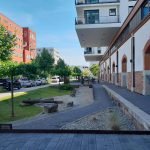
The tour lasts 90 minutes, is designed for groups of up to 25 people, and begins at Zollhallenplatz. The route takes participants through the former freight yard. There, topics such as stormwater management, urban green spaces, reducing impervious surfaces, shading, cooling, and mobility are explored in the context of modern neighborhood planning.

The program thus meets key selection criteria: a clear local focus, defined topics, a transparent organizational framework, and a level of detail that can be tailored to participants’ needs. It is particularly relevant for groups that not only view Freiburg as a sustainable city but also want to better identify and evaluate specific measures and conflicting goals.

The added value, therefore, lies not in a traditional sequence of well-known landmarks, but in the structured legibility of a modern neighborhood: Participants learn what questions they can ask about open spaces, buildings, vegetation, and traffic areas.

Common Objections Before Making a Decision

Is the tour easy to follow even without specialized knowledge?

Yes. No prior knowledge is required. However, when making a request, please specify whether you are interested in a general overview for tourists, an educational presentation, or an in-depth technical discussion. This will allow us to better tailor the presentation to your group.

Is this topic getting too technical?

Not necessarily. The tour focuses on visible examples on the grounds of the former freight yard. What matters most is that technical terms are explained on-site and linked to questions relevant to everyday life. Clearly specifying the desired level of detail reduces the risk of the presentation being too technical or too general.

What are the benefits of a guided tour compared to exploring on your own?

Many elements of a sponge city are difficult to recognize without context. A guided tour connects individual areas and design elements with stormwater management, heat protection, and neighborhood planning. It also provides an opportunity for questions and a discussion tailored to the group.

When does it make more sense to choose a different option?

A different tour is more appropriate when the focus is on historical landmarks, entertainment, or another sustainability-related topic. For topics such as housing, architecture, mobility concepts, and civic participation, Vauban is a more relevant choice. For an in-depth planning analysis with a comprehensive evaluation, a dedicated professional event may be more suitable than a 90-minute walking tour.

Here’s how to prepare for the next step

When making your inquiry, please specify the type of group, the approximate number of participants, their prior knowledge, their main interests, and the desired level of detail. Also, please indicate whether the tour is planned as a standalone event or in combination with a Vauban tour or another Freiburg activity.

Still not sure if the tour is right for your group?

Please briefly describe your group and your areas of interest. We’ll provide you with personalized advice on the best approach for your tour.

Questions about the Schwammstadt Freiburg City Tour

What is a sponge city?

A “sponge city” captures rainwater as close as possible to where it falls. Surfaces, soils, vegetation, and buildings are designed to store water, allow it to seep into the ground, or let it evaporate, rather than simply draining it away quickly. This supports measures to mitigate the effects of heavy rainfall, promotes urban green spaces, and helps alleviate heat stress.

Where does the "Sponge City" tour take place in Freiburg?

The tour begins at Zollhallenplatz and winds through the former freight yard. It does not take place in Freiburg’s Old Town.

How long does the tour last, and how large can the group be?

The listing specifies a duration of 90 minutes and a maximum group size of 25 people.

Do participants need any prior knowledge?

No. The content can be presented in a way that is accessible to a general audience, educational, or technical. The desired level of technical detail should be specified in the request.

Who is this tour intended for?

These include tour groups, companies, municipalities, expert delegations, universities, students, and school classes. The key criterion is a shared interest in climate adaptation and modern urban development.

What sets the Schwammstadt tour apart from the Vauban tour?

The “Sponge City” tour focuses on water, urban green spaces, heat protection, and climate adaptation. The Vauban tour focuses more on sustainable living, architecture, mobility, and citizen participation.

Can the two Green City tours be combined?

Yes. According to the offer page, a combination is possible. It is suitable when a group wants to compare different aspects of sustainable urban development.