

deen-usfres +49 (0) 7667 4269631 buchung@kultour-entdecken.com
+49 (0) 7667 4269631 buchung@kultour-entdecken.com
deen-usfres

Freemasons in Freiburg: How History Becomes Visible in the Cityscape

When you walk through Freiburg’s Old Town, you usually find yourself looking at the Münster, the Bächle, and historic facades. Less obvious are the traces of ideas, associations, and personal networks that have helped shape urban life. Freemasonry is one such example. However, its history cannot be understood simply by searching for mysterious symbols.

The direct answer: There is historical evidence of Freemasons in Freiburg dating back to 1784. Their presence is evident primarily in biographies, institutions, monuments, and surviving writings. Symbols may provide clues, but they do not, on their own, prove a connection. The historical context is what matters.

What is Freemasonry?

Freemasonry is an ethically oriented association organized into lodges. Its imagery draws on tools and concepts from the building trades: Human beings are symbolically understood as “rough stones” that they shape through self-knowledge and responsible action. Rituals and symbols bring moral questions to life.

Masonic organizations cite humanity, freedom, justice, and tolerance as important values. They do not consider themselves to be either a political party or a religious community. Some aspects of their traditions are reserved for members; however, their goals, organizations, and many activities are open to the public.

Modern organized Freemasonry developed in Great Britain in the early 18th century. Its connection to the tradition of stonemasons explains why the square, compass, and other motifs from the building trades continue to play an important role in its symbolism to this day.

Why Masonic History Is Important to a City

A city’s history is shaped not only by its buildings and government offices, but also by its universities, clubs, newsrooms, political debates, and personal connections. Examining the history of Freemasons can reveal how ideas related to the Enlightenment, education, and civic participation were discussed within a city.

Yet it would be too simplistic to attribute every liberal development to Masonic lodges. What is historically revealing are the specific individuals: What did they teach? What offices did they hold? In which institutions were they active? And what sources document the connection?

In this way, familiar places become more than just a backdrop. Facades, monuments, and street names raise questions about education, power, memory, and social change.

Freiburg and the “Zur edlen Aussicht” Lodge

The University Library of Freiburg traces part of its Masonic collection to the lodge “Zur edlen Aussicht,” whose history in Freiburg began in 1784. Among the founding members were Johann Georg Schlosser, Goethe’s brother-in-law and the first “Master of the Chair,” as well as Carl Schwarzl, a cathedral pastor and professor of moral theology.

These biographies alone refute simplistic stereotypes. Early Freemasonry in Freiburg was linked, in terms of its members, to the university and the church. This does not mean that these institutions themselves were Masonic. It does, however, show that social circles were more intertwined than modern labels would suggest.

Between 1813 and 1857, Freemasonry was banned in Baden. In 1935, the Freiburg Lodge of that time was dissolved under pressure from the Nazi regime; its lodge building had to be sold. Parts of its books and journals later found their way into the University Library and today form a digitally cataloged collection of Masonic materials. The University Library of Freiburg’s Masonic collection provides a source-based introduction to the subject.

What traces can be discovered in Freiburg’s cityscape?

Münsterplatz: A Biography That Bridges Different Worlds

At Münsterplatz, don’t bother looking for a supposed secret symbol—instead, take a look at Carl Schwarzl. The fact that a cathedral pastor and professor of moral theology was one of the lodge’s founding members makes this location a vivid example of the intersections of that era. Those who wish to explore ecclesiastical architecture in greater depth, regardless of this connection, can gain a broader art-historical context by taking a guided tour of the Freiburg Cathedral.

Town Hall Square: Monuments as Political Reminders

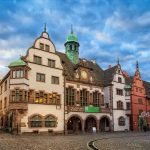
The Rotteck Monument illustrates just how fluid memory can be—in the literal sense. The monument to the liberal scholar and politician Carl von Rotteck was erected in 1848 on what is now Rathausplatz, removed as early as 1852, and later moved to several different locations. Such changes reveal which individuals a city chose to honor publicly at different times.

From a methodological standpoint, this is important when searching for traces of Freemasonry: A monument does not prove membership in a lodge. However, it raises questions about the liberal public sphere, political participation, and the networks through which ideas circulated.

University District: Facts Instead of Speculation

The university is significant both as a setting where historical figures were active and as a modern repository of historical sources. Those who research the digitized collections before visiting the Old Town will be better able to contextualize names, terms, and contemporary writings later on.

Facades and Symbols: Look Closely, Interpret Carefully

The square and compass together form the most well-known Masonic emblem. However, both tools existed long before organized Freemasonry. Even greater caution is required when it comes to individual stars, eyes, owls, triangles, or geometric ornaments: they can have religious, craft-related, heraldic, or purely decorative meanings.

A reliable attribution therefore requires a second point of reference, such as an inscription, a documented individual, the building’s history, or an archival source. The more fascinating discovery is often not the most spectacular symbol, but rather the traceable connection between a place and a person’s life story.

Common Misconceptions About Freemasons

The most common misconception is that Freemasons form an invisible world government. There is no historical basis for this. Conspiracy theories about an alleged “Jewish-Masonic” conspiracy were exploited for political purposes and used by the Nazis to justify exclusion and persecution. The U.S. Holocaust Memorial Museum documents the dissolution of lodges, the confiscation of their property, and the propaganda surrounding these events.

Equally misleading is the notion that all Freemasons pursued the same political goals. Lodges and members differed depending on the time, place, and orientation. Serious urban history therefore does not ask the sweeping question, “What did the Freemasons want?” but rather: What evidence is there regarding this person, this lodge, and this context?

Here’s how you can experience the topic firsthand

Any personal search for clues begins with a reliable source and a clear question. At Rathausplatz, the focus might be on political memory; in the university district, on education and tradition; on building facades, on the limits of symbolic interpretation; and at Münsterplatz, on Carl Schwarzl’s unusual biography. An overview of Freiburg’s classical city history provides additional context.

Those who don’t want to piece together the connections between people, symbols, and institutions on their own can explore Freiburg’s historical Masonic heritage in greater depth on a guided walking tour. According to the event page, the route leads from Rathausplatz through Rathausgasse and the university district, past the Martinstor, and on to Münsterplatz, contextualizing visible details within the history of education, politics, the press, the church, and the city.

Conclusion: Context is the real discovery

The history of Freemasonry in Freiburg is not a mystery that can be solved with a single symbol. It becomes tangible where buildings, monuments, biographies, and sources converge. It is precisely the interplay between the cityscape and archival records that makes this topic so rich.

If you take your time to look more closely and ask more detailed questions during your next visit to the Old Town, you’ll discover Freiburg as a place of enlightenment, conflict, remembrance, and social change. A guided tour led by an expert can help you piece together meaningful connections from individual details—without speculation or hasty myths.

After reading the historical overview, would you like to assess whether the topic and format of the tour are a good fit for your participants? If so , you can start by checking whether the Freemason tour is a good fit for your group. You can also find specific information about the tour’s organization under “Prices,” “Group Size,” and “Booking Details.”

Interesting Facts About the Freemasons in Freiburg

Since when have there been documented Freemasons in Freiburg?

The “Zur edlen Aussicht” Lodge has been documented since 1784. Its founding members included Johann Georg Schlosser and Carl Schwarzl.

Which Masonic lodge was there in Freiburg?

The central historic lodge was named “Zur edlen Aussicht.” Its history was marked by its ban, its reinstatement, and the dissolution of the organization under Nazi pressure.

How can you recognize a Masonic symbol?

The combination of a protractor and a compass is the best-known emblem. Individual tools, eyes, stars, or geometric shapes are not sufficient evidence on their own; their significance must be confirmed by the historical context.

Are Freemasons a secret society?

Lodges keep parts of their rituals and private discussions confidential. However, their existence, organization, and ethical goals are public knowledge. Therefore, the term “secret society” should not be equated with conspiracy theories.

What is the connection to the University of Freiburg?

Early members had academic backgrounds; Carl Schwarzl was a professor of moral theology. In addition, the university library preserves and digitizes historical Masonic literature.

Were Freemasons persecuted under National Socialism?

Yes. Lodges were dissolved or forced to disband, and their property and archives were confiscated. In Freiburg, the lodge that existed at the time ceased to exist in 1935 under pressure from the regime.

Is it possible to discover the trails without a guide?

Yes. It’s helpful to research sources, take a critical look at the interpretations of symbols, and focus on well-documented biographies. Above all, a guided tour makes it easier to place scattered clues within the broader context of the city’s history.