


deen-usfres +49 (0) 7667 4269631 buchung@kultour-entdecken.com
+49 (0) 7667 4269631 buchung@kultour-entdecken.com
deen-usfres

What Is a “Sponge City”? How Freiburg Is Rethinking Rainwater Management

After a heavy summer rain, it becomes clear within minutes how a city manages its water. On impervious surfaces, water quickly runs off into storm drains and the sewer system. In planted depressions, open ground, or green roofs, however, it is slowed down, stored, and, in some cases, returned to the natural water cycle. The “sponge city” concept is based precisely on this difference.

In a nutshell: A sponge city absorbs rain as close as possible to where it falls. It retains water, allows it to seep into the ground, stores it for plants, or releases it gradually through evaporation. This is intended to reduce flood risks, relieve pressure on the sewer system, and help densely built-up neighborhoods adapt to heat and drought.

What is a sponge city?

The term “sponge city” does not refer to a single technical system or a clearly defined neighborhood. Rather, it refers to a planning principle for managing stormwater. A city should behave more like natural soil: absorbing water, temporarily storing it, and releasing it slowly, rather than draining it from the urban area as quickly as possible.

To achieve this, “blue” and “green” elements are combined. Blue represents water, such as retention areas, open channels, ponds, or cisterns. Green includes trees, planted depressions, parks, and green facades and roofs. Together, they form blue-green infrastructure.

The Federal Environment Agency classifies the “sponge city” as a holistic, nature-based approach to climate adaptation. It is not merely a matter of absorbing excess water. The stored water is then intended to seep away, evaporate, or be used for irrigation, for example. In this way, the city moves closer once again to a natural water cycle.

The Federal Environment Agency provides an in-depth technical introduction to the “Sponge City” concept for the future.

Why Cities Can No Longer Simply Drain Rainwater

For a long time, an effective drainage system was considered good primarily if rainwater flowed quickly into the sewer system. In densely built-up cities, however, this creates two conflicting problems: During heavy rain, a large amount of water accumulates in a short period of time. During hot, dry periods, that same water is later lacking for the soil, trees, and evaporative cooling.

Freiburg, too, is experiencing this range of effects. The city points to hot summers, the Dreisam River’s occasionally dry riverbed, and heavy rainfall events as visible consequences of a changing climate. In the spring of 2025, a new climate adaptation strategy was therefore adopted as a strategic framework for current and future measures.

The “sponge city” principle seeks to address both of these challenges simultaneously. Rain is not treated merely as wastewater, but as a local resource. The more rainwater that remains in the neighborhood, the more it can nourish plants, help cool the area through evaporation, and drain away at a slower rate. Blue-green infrastructure can thus not only support water retention but also enhance the quality of life and well-being in densely built-up urban areas.

Sponge City Explained Simply: How It Works

A water-sensitive city does not rely on a single large-scale solution, but rather on many decentralized components.

On rooftops, green roofs and retention systems can absorb some of the precipitation. Water is stored in the substrate, used by plants, or released gradually. Cisterns also allow for later use, such as for irrigation.

On streets and in public squares, permeable paving, sunken planting areas, tree pits, and depressions can help. It is crucial that water be able to reach these areas effectively. A planted deep bed will be ineffective if high curbs prevent any water from flowing into it.

In green spaces and open areas, spaces can serve multiple purposes. A meadow, a playground, or an open space can be used normally in dry weather and temporarily absorb water when it rains. This multifunctional use is particularly important because climate adaptation in compact cities requires space.

The measures planned by Freiburg include, among other things, retention roofs, rooftop gardens, evaporation beds, basins, infiltration trenches, cisterns, open ditches, and water-sensitive traffic areas.

During exceptionally heavy rainfall, conventional storage and infiltration measures alone are not always sufficient. In such cases, additional retention areas, safe drainage routes, and property protection are required. The “sponge city” concept and heavy rainfall preparedness therefore go hand in hand, but they are not identical. Even technical and nature-based drainage systems can be overwhelmed during exceptional events.

Why Freiburg Is a Good Example

Freiburg has developed an urban climate adaptation strategy for the area of rainwater management. Its guiding principles combine a more nature-based water cycle, the use of rain as a resource, water-sensitive open spaces, and municipal heavy rain preparedness. The plan applies to both new development areas and the redevelopment of existing neighborhoods.

This is not merely a non-binding informational brochure. Pursuant to a city council resolution passed in March 2024, the “Rainwater” Climate Adaptation Concept must be incorporated into the formal urban land-use planning process as an urban development concept. Its findings are also to be incorporated into further urban planning initiatives, design competitions, and the Freiburg Land Use Plan 2040.

It is important to distinguish between frequent normal rainfall and exceptional heavy rainfall. Normal precipitation should be retained and utilized within the urban area as much as possible. For rare, particularly intense events, additional land-based flood control measures, retention capacity, and safe pathways for surface water are required.

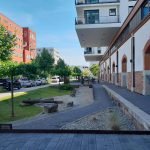
This approach is clearly evident at Zollhallenplatz in the freight yard area. There, underground storage space is combined with retention features in planting and recreational areas. As a result, the surface does not look like a purely technical drainage system, but rather like a thoughtfully designed public space.

The city of Freiburg cites Zollhallenplatz as an example of a plaza designed to minimize runoff. Other documented measures include a deep planter on Richard-Künzer-Straße that collects water from the street, as well as planted infiltration basins at Staudinger School.

Freiburg thus also demonstrates that “Green City” encompasses more than just solar panels or bicycle traffic. Water management, urban green spaces, open-space planning, and quality of life are all intertwined. Those who wish to explore this broader context in greater depth will find additional perspectives in the guide to the characteristics of a sustainable neighborhood and in the article on Freiburg-Vauban as a “Green City” example.

Freiburg, the “Sponge City”: Where the Concept Is Already Taking Shape

Many elements only stand out once you know what to look for. A sunken flower bed next to a street may not just be a design feature, but also serve to collect rainwater runoff. A shallow depression in the lawn can serve as a temporary reservoir. Small openings in the curb indicate that water is intentionally being directed from the roadway into a green space.

Tree locations are also revealing. Large planting areas, water-permeable surfaces, and visible runoff channels increase the likelihood that precipitation will reach the root zone. On buildings, green roofs, planted terraces, or visible storage elements indicate decentralized rainwater management.

However, what matters most is not the individual feature, but the connection between them. Effective solutions form what is known as a “rainwater cascade”: from the roof, through patios and planting areas, to basins, swales, or cisterns. Water is slowed down at several stages before any remaining excess flows on.

The Impact of These Measures on Daily Life

“Sponge City” measures can serve multiple functions at once. They retain runoff, support urban trees, promote evaporation, and create greener public spaces. The city of Freiburg specifically identifies the integration of water and vegetation as a key feature of water-sensitive urban development.

However, these measures also present conflicting objectives. Storage areas require space, facilities must be maintained, and inflows must be kept clear. Not all soils are equally suitable for infiltration, and not every measure is appropriate for every location. Topography, soil conditions, groundwater, development, and land use must therefore be taken into account in the planning process.

A “sponge city” is therefore not created simply by having more green spaces. What matters is whether water actually reaches these areas, can be safely stored there, and whether the individual components function as a cohesive system.

With measures like these, Freiburg is gradually becoming a climate-resilient city that is better equipped to cope with heat, drought, and heavy rainfall.

Common Misconceptions About the Sponge City

“A few green roofs don’t make a city a ‘sponge city.’” Green roofs are an important component. Only the coordinated interaction of buildings, streets, open spaces, vegetation, and drainage results in a resilient system.

“The concept is intended only for heavy rainfall.” In fact, everyday rain plays a central role. It should remain in the local area as much as possible and be available to the soil, plants, and for cooling during dry periods. Freiburg therefore makes a conceptual distinction between managing normal rainfall and preparing for exceptional heavy rainfall events.

“A ‘sponge city’ prevents all flooding.” It can’t. Extreme events can overwhelm both technical and nature-based systems. That’s why additional emergency drainage routes, retention areas, and protective measures for buildings are needed.

“That only works in new neighborhoods.” In new construction, cascades and storage systems can be incorporated into the plans at a very early stage. However, existing streets, schoolyards, rooftops, and plazas can also be unsealed, greened, or redeveloped with water sensitivity in mind during renovations. The Freiburg concept explicitly takes into account both new construction and adaptations to existing structures.

Here’s how you can experience the topic firsthand

When taking a walk through the city, it’s worth looking down from the buildings to the ground: Where does the rainwater come from? Where does it go? Which areas are allowed to fill up temporarily? Does the rainwater reach the trees, or does it disappear straight into the storm drain? Questions like these suddenly bring urban planning into focus.

The former Freiburg freight yard site is particularly well-suited for this purpose because it allows for a close examination of the interrelationships between water, green spaces, mobility, and public spaces. A guided tour of water-sensitive urban development in Freiburg begins at Zollhallenplatz and places the visible measures within the broader context of stormwater management, heat protection, and neighborhood planning. Modern urban stormwater management combines retention, infiltration, storage, and evaporation into a decentralized system.

Conclusion: Understanding the City as Part of the Water Cycle

The “sponge city” is not just a decorative environmental label, but a different approach to land use and rainwater management. It does not start by asking how water can be drained as quickly as possible, but rather where it can be safely retained, nourish plants, and help cool the city.

Those who recognize these connections in the cityscape will see streets, rooftops, and green spaces in a whole new light. To help you determine which Green City format is right for your group, we offer a gentle introduction to the topic without any immediate pressure to book. Which guided tour of Freiburg—the “Sponge City”—is right for your group?

Frequently Asked Questions About the Sponge City

What is a sponge city, in one sentence?

A “sponge city” retains rainwater locally, stores it, allows it to seep into the ground, or uses it for plants and evaporation, rather than draining it away completely right away.

What measures are part of a sponge city?

Typical examples include green roofs or water-retaining roofs, cisterns, permeable paving, infiltration basins, tree trenches, deep plant beds, open gutters, unpaved areas, and multifunctional retention areas.

What does "blue-green infrastructure" mean?

“Blue” refers to water bodies and stormwater management systems, while “green” refers to vegetation and unpaved open spaces. Together, they support water retention, evaporative cooling, urban ecology, and quality of life.

Does the "sponge city" principle help combat heavy rainfall?

It can retain water, reduce peak flow rates, and relieve pressure on the sewer system. However, it does not provide complete protection. In the event of exceptionally heavy rainfall, additional retention areas, safe flow paths, and property protection are required.

Is Freiburg already fully a "sponge city"?

“Sponge City” is less a finished state than a long-term planning principle. Freiburg has developed a citywide concept for this purpose, which is to be incorporated into urban and land-use planning and implemented gradually through measures in various locations.

Where can you see "Sponge City" initiatives in Freiburg?

Among other things, the city cites Zollhallenplatz, a sunken garden on Richard-Künzer-Straße, and infiltration basins at Staudinger School as examples. The basic principles can also be seen in green roofs, sunken planting areas, and open spaces designed with water sensitivity in mind.