



A sustainable neighborhood combines eco-friendly living, climate-friendly mobility, green spaces, and a reliable social infrastructure. What matters is not a single measure, but the interplay across the entire neighborhood: Are everyday destinations easily accessible? Do open spaces remain livable despite dense development? Do buildings, open spaces, and transportation routes support a resource-efficient daily life? Only when ecological, social, and economic goals are considered together can a neighborhood that is sustainable in the long term be created.
Four areas are particularly important:
A green roof alone does not make for a sustainable neighborhood. Similarly, an energy-efficient building is not enough if every trip has to be made by car.
Short distances make everyday life easier and reduce dependence on private cars. To achieve this, housing, work, shopping, education, and leisure activities must be thoughtfully connected. Safe walking and biking paths, as well as easily accessible public transportation, are therefore not merely supplementary features but central components of sustainable neighborhood development.
Trees, parks, and green courtyards do more than just make a neighborhood more attractive. They can provide shade, absorb rainwater, and reduce the heat buildup in densely built-up areas. At the same time, they create spaces for physical activity, relaxation, and social interaction. Green roofs, green facades, and permeable surfaces can also help a neighborhood better adapt to high temperatures and heavy rainfall.
A sustainable neighborhood needs schools, daycare centers, shopping options, recreational opportunities, and spaces for community activities. Accessible pathways make it easier for as many people as possible to participate in public life.
A neighborhood becomes economically sustainable when its buildings and infrastructure are durable, adaptable, and thoughtfully interconnected. This creates a quality of life that is environmentally, socially, and practically sound.
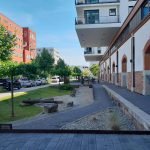
Many of these principles can be seen in the Vauban neighborhood of Freiburg. The neighborhood combines a traffic plan designed to reduce car use with walking and biking paths, energy-efficient construction, green spaces, and social infrastructure. The city of Freiburg describes Vauban as a model “Green City” project and highlights, among other things, low-energy and passive construction, green roofs, preserved tree cover, and facilities for education, community interaction, and recreation.
Vauban thus vividly demonstrates how a sustainable neighborhood can function in everyday life. Anyone interested in learning about the local context can take a guided tour to discover how mobility, architecture, energy, open spaces, and the neighborhood all interconnect.
For more information on Freiburg Vauban—Green City, see the articles “Vauban Freiburg: Why This Sustainable Neighborhood Is Considered a Global Model ” and “Discover Vauban—A Guided Tour of Freiburg’s Sustainable Model Neighborhood.”
| Cookie | Duration | Description |
|---|---|---|
| cookielawinfo-checkbox-advertisement | This cookie is used to record the user's consent for cookies in the "Advertising" category. | |
| cookielawinfo-checkbox-analytics | This cookie is used to record the user's consent for cookies in the "Analytics" category. | |
| cookielawinfo-checkbox-functional | The cookie is set to record the user's consent for cookies in the "Functional" category. | |
| cookielawinfo-checkbox-necessary | This cookie is used to record the user's consent for cookies in the "Necessary" category. | |
| cookielawinfo-checkbox-others | This cookie is used to store the user's consent for cookies in the "Others" category. | |
| cookielawinfo-checkbox-performance | This cookie is used to store the user's consent for cookies in the "Performance" category. |
| Cookie | Duration | Description |
|---|---|---|
| CookieLawInfoConsent | No description |