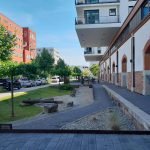



Vauban Freiburg is considered a model neighborhood for sustainable urban development. The neighborhood combines energy-efficient construction, car-reduced mobility, green spaces, short distances, and community-oriented living arrangements. What matters most is not a single environmental measure, but the interplay of urban planning, architecture, transportation, and social life.
Vauban thus exemplifies the character of Freiburg as a “Green City.” Here, sustainability is not merely a technical concept; it shapes the design and use of an entire neighborhood.
The site of today’s neighborhood was once home to a barracks that was used by French military forces after World War II. After their withdrawal in 1992, planning for a new neighborhood began.
From the very beginning, the urban planning goals included energy-efficient construction, prioritizing walking, biking, and public transportation, preserving green spaces, and integrating residential and commercial areas. In 1998, the first new residents moved in.
Vauban thus did not become known for a single model building. The neighborhood was developed as a cohesive concept for sustainable living.
In Freiburg, the term “Green City” refers to the interplay between environmental policy, renewable energy, sustainable mobility, citizen participation, and quality of life. In Vauban, these areas are evident at the neighborhood level.
Among other things, the following are defining characteristics:
Vauban’s uniqueness, therefore, does not lie in any single innovation. His role as a model stems from the combination of technical, urban planning, and social decisions.
Vauban is often referred to as a car-free neighborhood. However, the correct term is “low-traffic neighborhood.”
Many residential streets do not have public parking spaces. A large proportion of private vehicles are parked in neighborhood garages. As a result, residential areas remain largely free of parked cars and can be used more extensively as spaces for relaxation, socializing, and play.
At the same time, the neighborhood offers alternatives to private cars. Trams, buses, bike paths, and car-sharing services connect Vauban with other parts of Freiburg. This shows that sustainable mobility doesn’t work through restrictions alone. It requires options that are practical for everyday use and urban planning that minimizes travel distances.
Vauban set binding standards for energy consumption early on. In addition to low-energy buildings, passive houses and particularly energy-efficient housing projects were built.
The neighboring solar housing development, with its energy-plus houses, plays a special role. Its energy concept is designed to generate more energy over the course of a year than is consumed in the building.
Green spaces and stormwater were also incorporated into the planning. Public green corridors, play areas, and open spaces provide places for people to gather and relax, even amid dense development. Stormwater is channeled through open gutters to infiltration areas, ensuring that a large portion of it remains within the neighborhood.
This connection also makes Vauban relevant to issues of climate-adapted urban development. A “Sponge City” and “Green City” tour in Freiburg explores this aspect in greater depth using additional examples from the city.
In Vauban, sustainability is evident not only in buildings and transportation plans. Part of the neighborhood was developed through building cooperatives and community-organized housing projects.
This allowed residents to have a greater say in how buildings, apartments, and shared spaces were designed. Neighborhood initiatives, gathering places, and communal spaces continue to contribute to the social character of the neighborhood to this day.
Vauban is therefore not merely a technical environmental project. The neighborhood demonstrates how urban planning can also foster social interaction, participation, and community action.
Vauban’s principles cannot be applied unchanged to every city. Land area, transportation links, political conditions, and the needs of the population all vary.
However, certain key principles can be applied:
This is where Vauban’s international significance lies: The neighborhood does not provide a template to be copied, but rather concrete solutions for livable and sustainable urban neighborhoods.
Many distinctive features are hardly noticeable during a walk. Without background knowledge, all you see are residential buildings, streetcar tracks, green spaces, and traffic-calmed streets. Why these elements were arranged this way and how they interact often remains hidden.
During a guided tour of Freiburg-Vauban, the historical context is explained right on the spot. Among other things, visitors will learn:
The tour is ideal for visitors to Freiburg as well as for groups interested in architecture, urban planning, mobility, or sustainability.
Vauban is considered a model neighborhood for Freiburg’s “Green City” initiative. Here, sustainable mobility, energy-efficient construction, green spaces, and community-based living arrangements are all brought together.
No. Vauban has reduced car traffic. Many vehicles are parked in neighborhood garages rather than directly in front of the residential buildings.
Yes. However, many planning, energy, and social interrelationships are difficult to understand without an explanation.
Would you like to not only see Vauban but also understand the ideas behind the neighborhood? On our guided tour of Freiburg-Vauban, you’ll experience the mobility concept, architecture, energy solutions, and community-based living arrangements firsthand at each location.
You can find more interesting articles on the topic of Freiburg Vauban – Green City on our website.
| Cookie | Duration | Description |
|---|---|---|
| cookielawinfo-checkbox-advertisement | This cookie is used to record the user's consent for cookies in the "Advertising" category. | |
| cookielawinfo-checkbox-analytics | This cookie is used to record the user's consent for cookies in the "Analytics" category. | |
| cookielawinfo-checkbox-functional | The cookie is set to record the user's consent for cookies in the "Functional" category. | |
| cookielawinfo-checkbox-necessary | This cookie is used to record the user's consent for cookies in the "Necessary" category. | |
| cookielawinfo-checkbox-others | This cookie is used to store the user's consent for cookies in the "Others" category. | |
| cookielawinfo-checkbox-performance | This cookie is used to store the user's consent for cookies in the "Performance" category. |
| Cookie | Duration | Description |
|---|---|---|
| CookieLawInfoConsent | No description |